
Harvia’s journey to mitigate climate change
Harvia Group’s Climate Transition Plan 2025–2050 maps out our ambitious journey to achieve net zero emissions by 2050. This plan aligns with global climate targets, including the EU’s goals and the Paris Agreement’s 1.5 °C ambition.
To ensure we’re on the right track, our roadmap is built on internationally recognized pathways like the IPCC and IEA Net Zero scenarios. We are prioritizing emission reductions (90–95%) across our entire value chain (Scopes 1, 2, and 3) first, reserving high-quality offsetting only as a last resort for any remaining, unavoidable emissions in the final phase.

This comprehensive program is powered by a variety of strategies to cut carbon, including:
- Boosting energy efficiency and increasing electrification by phasing out fossil fuels like oil heating and upgrading production processes.
- Increasing our use of renewable or emission-free energy by investing in solar power and other emission-free energy sources.
- Embracing circular economy principles and resource efficiency by increasing recycled and low-carbon materials in products and packaging.
- Decarbonizing our supply chain by introducing climate criteria in procurement and improving supplier GHG data management.
- Innovating our product and service portfolio by developing low-emission sauna concepts and designs for durability and recyclability.
- Adopting cutting-edge new technologies by developing sauna solutions utilizing new technologies such as hydrogen and future energy storage solutions.
Our plan details specific Scope 1, 2, and 3 emission targets and actions, ensuring we meet regulatory standards like the CSRD and EU Climate Law. It also emphasizes circular economy principles and strategically tackles our biggest emission sources. Our understanding of climate resilience, gained from a 2024 analysis, is also built into this plan.

Our transition pathway: 2025–2050
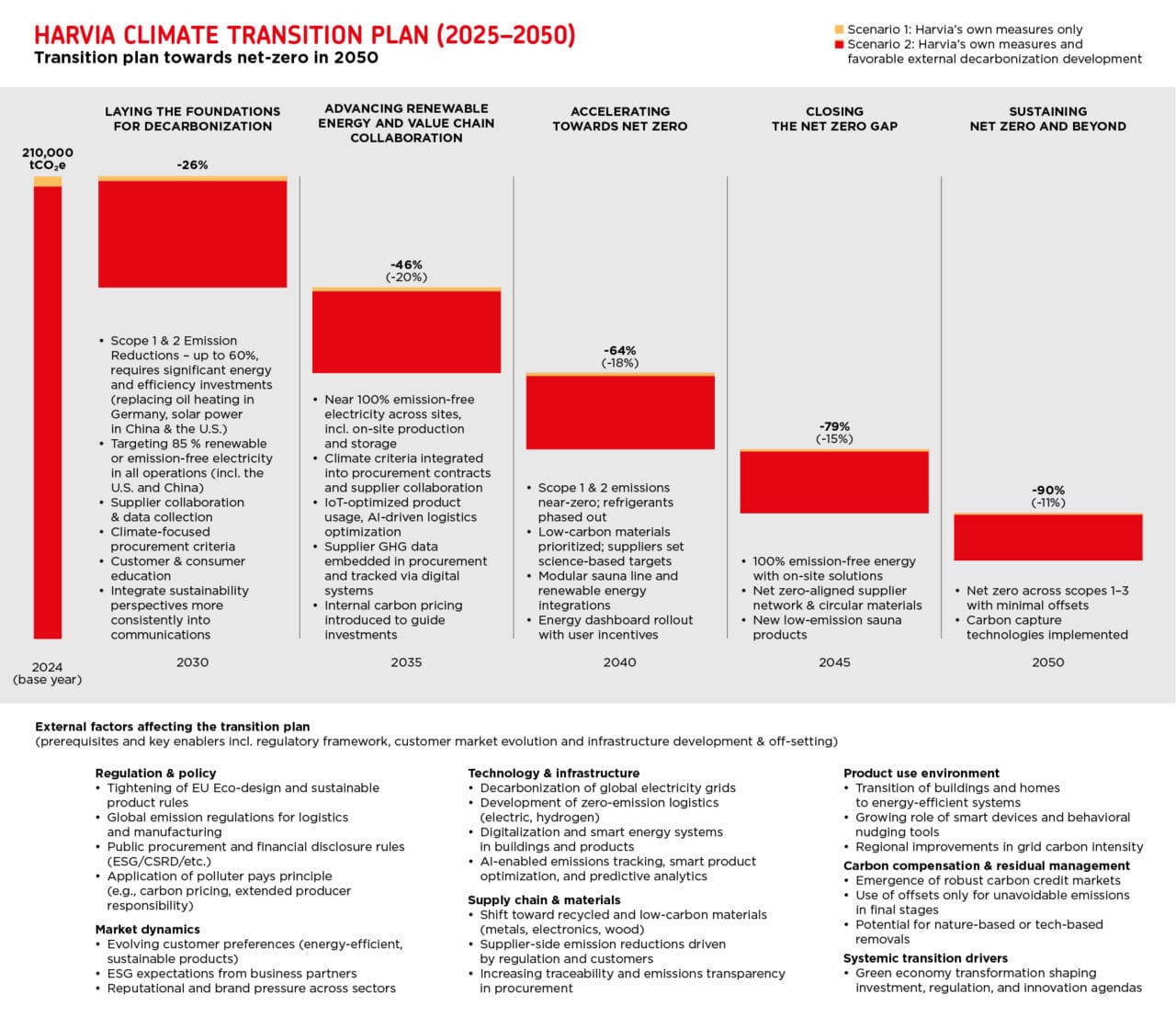
This 25-year pathway outlines five-year reduction periods, each with expected emission reductions and priority actions. We recognize that external factors like evolving regulations, market dynamics, technological advancements, and supply chain developments will support our progress. We also know this journey requires significant investment, for example, in advanced technology at Harvia facilities and in ongoing research and development. High-quality offsetting will only be considered as a supportive step in the very final phase (2045–2050) to balance the small amount of emissions that cannot be reduced internally.
Our emission scenarios: Charting the course
To understand our potential, we have developed two emission scenarios:
Scenario 2 (Harvia’s own measures and favorable external decarbonization): This is our more ambitious path, combining our internal efforts with significant industry transformation and technological development. This includes advancements like low-carbon materials, electrified logistics, and the global decarbonization of electricity grids. This scenario foresees our Scope 1 and 2 emissions being virtually eliminated by 2040 and projects an impressive 90% total emission reduction by 2050.
Scenario 1 (Harvia’s own measures only): This scenario shows what we can achieve purely through our own actions and investments, without relying on wider industry shifts or market developments. It focuses on internal decisions and collaborations that Harvia can independently initiate and implement, including bringing Scope 1 and 2 emissions close to zero by 2040. Even with this cautious approach, we project a 9% total emission reduction by 2050.
Key focus areas and actions over time
Our actions will guide our efforts over time:
2025–2030: Laying the foundation
- Phasing out fossil fuels.
- Investing in emission-free energy generation, such as solar power.
- Integrating sustainability into our communications.
- Introducing climate criteria in procurement.
2030–2035: Accelerating progress
- Advancing emission-free and renewable energy use.
- Deepening value chain collaboration.
- Improving supplier emissions data management.
- Transitioning to low-carbon logistics.
2035–2040: Nearing net zero
- Eliminating nearly all Scope 1 and 2 emissions.
- Promoting new, sustainable sauna concepts.
- Expanding circular economy principles in product development.
2040–2045: Deepening value chain impact
- Deepening collaboration with key suppliers to achieve Scope 3 reductions.
- Scaling up the use of low-carbon and circular materials across product lines.
- Launching low-emission sauna products.
2045–2050: Sustaining net zero
- Exploring innovations such as integrating saunas into energy storage systems.
- Maintaining net zero status primarily through ongoing in-house and value chain emission reductions.
- Complementing efforts with limited use of high-quality carbon credits for residual emissions.
Addressing challenges and embracing opportunity
Currently, some emissions are ‘locked-in’ due to existing technology and market limitations. However, based on expected advancements in low-carbon technologies, renewable energy availability, and regulatory developments, we expect these challenges to be overcome by 2050, enabling full alignment with our net-zero target. We recognize that there are uncertainties ahead, such as policy shifts, the pace of energy system decarbonization in key markets, the availability and cost of low-carbon technologies and materials, the scalability and credibility of carbon removals, and evolving market and consumer dynamics. We are prepared to adapt and innovate as these factors develop.
Our Climate Transition Plan is fully integrated into our core strategy, inspiring new solutions, driving innovation, and continuously improving our operations with a strong focus on energy efficiency and emission reductions. It’s how Harvia contributes to a good and long life for all, with minimal environmental impact.